


- Aug 31, 2023
- 160
- 498
- 63
Always love seeing what tweaks Toyota makes to their GR Yaris when they go racing. I’ve been digging through photos and videos of the TG-RR GR Yaris from the 2025 Nürburgring 24h to see what’s different. I’m mainly interested in the stuff we can actually adapt for our own cars to improve reliability and performance for track days and daily driving. Here’s what caught my eye.
Cold Air Supply
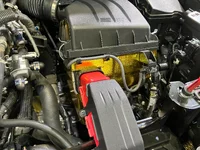
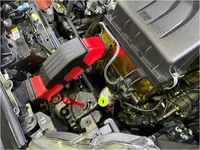
The TG-RR Yaris uses the standard airbox, but it’s insulated with thin foam and wrapped in gold heat-reflective foil to prevent heat soak.
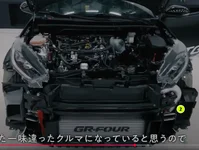
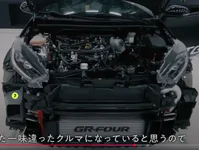
There’s also a cold air duct (1) running from the front bumper (2). The inlet is just above the LH brake cooling duct and outlets directly toward the airbox flap.
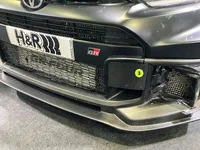
Rookie Racing had issues with water getting into the filter during heavy rain in Super Taikyu while running similar ducting. I’m pretty sure that’s why they came up with a simple cover for this inlet (3).
MAP Sensor Cooling
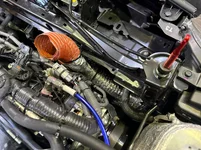
This is what Toyota has always done with their endurance racing GR Yaris. Since I don’t recall anyone having issues with these sensors, I tend to think the main reason is to reduce heat soak and the resulting performance loss rather than to improve the reliability of the sensor.
The GR Yaris runs two MAP sensors, one after the intercooler and one in the manifold. What I find interesting is that Toyota seems to be cooling only the one in the manifold.
Also, one would think it would be easier to use a short duct from the upper RH opening in the front bumper, similar to the LH one that feeds the air box. But for some reason they chose not to and instead placed the inlet above the RH brake cooling duct (4).
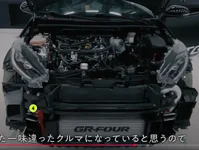
Engine Oil Catch Tank
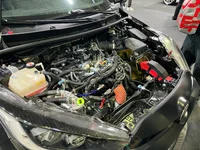
Regulations do not require oil catch tank if car is running closed-loop PCV system. But they added one anyway (5). That suggests that under high-G cornering and constant high RPM the stock separation just isn’t enough.
Engine Coolant Expansion Tank
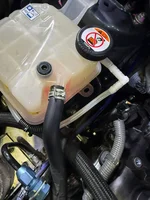
Even though the Gen 2 tank is taller to stop spillover, it looks like it’s still not quite enough for track abuse. They’ve routed the overflow to an external container just to be safe.
Engine Oil Cooling
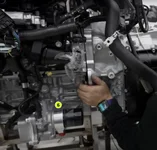
TG-RR are still using the standard Gen 2 heat exchanger but with a sandwich plate (6) to run an extra oil cooler. Hard to tell if it’s thermostat controlled or not. I’m guessing they swapped out the auxiliary coolant sub-radiator on the RH side for an oil cooler, since the ducting looks custom (7).
Misc Observations
Blue Line: you probably noticed that blue line on the intake manifold. That runs to an external boost pressure sensor for the scrutineering data logger.
Dipstick: retention hook (8) is used to stop the dipstick from popping out.
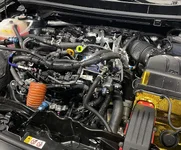
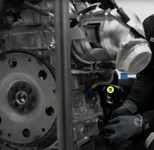
Turbo Drain: Stock drain pipe is gone, replaced with a braided line and AN fittings (9). Toyota must be well aware of the standard pipe issues.
These modifications might not look like much, but they serve a purpose. If Toyota engineers believe these simple tweaks are worth doing for the N24, they are likely worth considering for our own builds, too.
Cold Air Supply
The TG-RR Yaris uses the standard airbox, but it’s insulated with thin foam and wrapped in gold heat-reflective foil to prevent heat soak.
There’s also a cold air duct (1) running from the front bumper (2). The inlet is just above the LH brake cooling duct and outlets directly toward the airbox flap.
Rookie Racing had issues with water getting into the filter during heavy rain in Super Taikyu while running similar ducting. I’m pretty sure that’s why they came up with a simple cover for this inlet (3).
MAP Sensor Cooling
This is what Toyota has always done with their endurance racing GR Yaris. Since I don’t recall anyone having issues with these sensors, I tend to think the main reason is to reduce heat soak and the resulting performance loss rather than to improve the reliability of the sensor.
The GR Yaris runs two MAP sensors, one after the intercooler and one in the manifold. What I find interesting is that Toyota seems to be cooling only the one in the manifold.
Also, one would think it would be easier to use a short duct from the upper RH opening in the front bumper, similar to the LH one that feeds the air box. But for some reason they chose not to and instead placed the inlet above the RH brake cooling duct (4).
Engine Oil Catch Tank
Regulations do not require oil catch tank if car is running closed-loop PCV system. But they added one anyway (5). That suggests that under high-G cornering and constant high RPM the stock separation just isn’t enough.
Engine Coolant Expansion Tank
Even though the Gen 2 tank is taller to stop spillover, it looks like it’s still not quite enough for track abuse. They’ve routed the overflow to an external container just to be safe.
Engine Oil Cooling
TG-RR are still using the standard Gen 2 heat exchanger but with a sandwich plate (6) to run an extra oil cooler. Hard to tell if it’s thermostat controlled or not. I’m guessing they swapped out the auxiliary coolant sub-radiator on the RH side for an oil cooler, since the ducting looks custom (7).
Misc Observations
Blue Line: you probably noticed that blue line on the intake manifold. That runs to an external boost pressure sensor for the scrutineering data logger.
Dipstick: retention hook (8) is used to stop the dipstick from popping out.
Turbo Drain: Stock drain pipe is gone, replaced with a braided line and AN fittings (9). Toyota must be well aware of the standard pipe issues.
These modifications might not look like much, but they serve a purpose. If Toyota engineers believe these simple tweaks are worth doing for the N24, they are likely worth considering for our own builds, too.


