

GR Yaris Rötheli Racing GR Yaris
- Thread starter Phil1291
- Start date
You are using an out of date browser. It may not display this or other websites correctly.
You should upgrade or use an alternative browser.
You should upgrade or use an alternative browser.


Hahaha. Yeah.Change your correction factor and claim a world record
Can’t wait to see this thing rip man. October can’t come quick enough


If we have the chance, we‘ll do a Quartermile run and a 100-200 in full racetrim, so we get some perspective of how fast it is.

- Dec 6, 2021
- 159
- 400
- 63
Hahaha. Yeah.
If we have the chance, we‘ll do a Quartermile run and a 100-200 in full racetrim, so we get some perspective of how fast it is.
The real challenge is doing it without the Swiss military mobilising and sending you to jail forever
Well. You must know.If he lined up next to Aussie cars he’d be left for dead…. It’s cute the faith you have in your BF though xx

I don‘t think it‘s a good idea to insult people on the forum because you don‘t agree. You might wanna reconsider.As much as your lap dog does….
Last edited:
- Dec 6, 2021
- 159
- 400
- 63
You really need to chill fella. Only one getting personal is you. Go tidy up your shitshow in the other threadPhil go preach to your Scottish buddy…. And I’d suggest you don’t buy into the BS he is spreading as you hardly have the credentials to try out gunning PTA or other Aussie shops.
When you fail to shut down claims or even play into them you become just as bad as him.


Michael Knight
Totally Hooked
Engine looks nice (of course!) but the inlet diameter change from black stock pipe to blue large pipe is confusing - wouldn't it been smarter to use constant diameter in inlet pipework not to change the flow speed to the turbo (ie. would improve spool?) Or was the logic that its only about backpressure on turbo inlet and flow speed doesn't really matter (as air has mass I think it should but as not a proper engineer, just guessing)
I‘m no engineer myself.Engine looks nice (of course!) but the inlet diameter change from black stock pipe to blue large pipe is confusing - wouldn't it been smarter to use constant diameter in inlet pipework not to change the flow speed to the turbo (ie. would improve spool?) Or was the logic that its only about backpressure on turbo inlet and flow speed doesn't really matter (as air has mass I think it should but as not a proper engineer, just guessing)

The logic was to test the turbo first with an otherwise known intake, to see how it responds and how it is compared to the other Turbo‘s we used in the past.
The goal is to have a 76mm intake pipe all the way to the air filter.
But for the first few tests, we wanted to see how good/bad the turbo works with the stock pipe. Also because we‘re going to sell that turbo in the future and not everyone has/wants a huge intake pipe for whatever reason.


I know this is mostly about clutch power delivery but lightening the flywheel has the bonus of reducing the inertia of the driveline and the amount of energy sapped from the engine accelerating the flywheel. The engine doesn't see 1250kg plus driver plus... It sees that weight divided by whatever gear ratio it is in. From an acceleration point of view lightening the flywheel has an added effect to lightening the car. Lightening the car reduces the mass of the car and therefore inertia the engine has to move. Lightening the flywheel also reduces the rotational inertia of the engine and the effect from flywheel lightening is more pronounced in lower gears.
Vizard said it much better in "How to modify your mini" and taking his formula the effect of each 1kg or banana of lighter flywheel is found from the following (using fruit sadly):
(0.5*n^2*r^2 + R^2)/R^2
n is total gear ratio (gear ratio * final drive)
r is the radius of gyration of the flywheel in inches
R is the radius of the wheel/tyre in inches
I don't know what the radius of gyration of the flywheel is but the bigger the number the greater the influence. From what I have read on the webby thing the clutch is 240mm in diameter and a big chunk of weight is outside the clutch but this is just for rough calcs so I am making the assumption that the radius of gyration of the flywheel assembly is 75mm (3"). Since I also don't know what the gear ratios are in that box I can use the stock values of 3.538; 2.238; 1.535 for the first three with a final ration of 3.941 giving overall ratios of 13.943; 8.82 and 6.049.
Chucking these into the formula indicates that the 5.41kg saved is akin to the car getting a weight reduction of 36kg in 1st gear; 17.5kg in 2nd and 11kg in 3rd.
Vizard said it much better in "How to modify your mini" and taking his formula the effect of each 1kg or banana of lighter flywheel is found from the following (using fruit sadly):
(0.5*n^2*r^2 + R^2)/R^2
n is total gear ratio (gear ratio * final drive)
r is the radius of gyration of the flywheel in inches
R is the radius of the wheel/tyre in inches
I don't know what the radius of gyration of the flywheel is but the bigger the number the greater the influence. From what I have read on the webby thing the clutch is 240mm in diameter and a big chunk of weight is outside the clutch but this is just for rough calcs so I am making the assumption that the radius of gyration of the flywheel assembly is 75mm (3"). Since I also don't know what the gear ratios are in that box I can use the stock values of 3.538; 2.238; 1.535 for the first three with a final ration of 3.941 giving overall ratios of 13.943; 8.82 and 6.049.
Chucking these into the formula indicates that the 5.41kg saved is akin to the car getting a weight reduction of 36kg in 1st gear; 17.5kg in 2nd and 11kg in 3rd.

Spirited
Totally Hooked
- Jan 23, 2022
- 488
- 501
- 93
Congratulations on the e-shop, @Phil1291.
I see that you now offer two shifters; the CAE & the HRE one. I've learned a lot about the CAE shifter, largely through you and other forumites. I don't seem able to find much about the HRE shifter or the brand.
As both shifters are around the £1k mark (plus/minus 10%), a comparison video would be great if/when you get a chance
I see that you now offer two shifters; the CAE & the HRE one. I've learned a lot about the CAE shifter, largely through you and other forumites. I don't seem able to find much about the HRE shifter or the brand.
As both shifters are around the £1k mark (plus/minus 10%), a comparison video would be great if/when you get a chance
Agreed. Good idea.Congratulations on the e-shop, @Phil1291.
I see that you now offer two shifters; the CAE & the HRE one. I've learned a lot about the CAE shifter, largely through you and other forumites. I don't seem able to find much about the HRE shifter or the brand.
As both shifters are around the £1k mark (plus/minus 10%), a comparison video would be great if/when you get a chance
And i had two CAE shifters in the past two weeks here.
Missed that opportunity…

But we‘ll get more.
Spirited
Totally Hooked
- Jan 23, 2022
- 488
- 501
- 93
Agreed. Good idea.
And i had two CAE shifters in the past two weeks here.
Missed that opportunity…
But we‘ll get more.
Another favourite mod is the steering wheel extender. And its clientele, just like the CAE/HRE clientele, is likely to have a strong focus on ergonomics.
At over £1k for the two mods combined (steering wheel spacer & shifter), a low-cost mod to tilt the shifter towards the rear or diagonally towards rear & driver would be a great option. @MagnusT had asked the question in the past, ie whether the CAE can be mounted in a way that gets the gear knob a bit further towards the rear, since the steering wheel has moved quite a bit closer to the driver.
He was wondering if spacers for the two front shifter base mounts would do the job and if, in that case, the linkage would still be okay and working fine despite the front of the base being elevated slightly and at a small angle.
There is a product by Cusco that makes me feel hopeful. Shifter Offset Collar Kit (Product code 1C7-936-A) is supposed to tilt the shifter towards the steering wheel. The price is redicilously high, so I trust they ensured the elevation doesn't affect the functionality of the linkage and whole system.
Of course, they offer a tilt towards the steering wheel, while we are probably looking for a tilt towards the rear, or both rear & steering wheel, which perhaps could be achieved simply by installing the longer Cusco parts at the front instead of the side.
Or there could be a combination of three of the longer Cusco parts and one shorter, to tilt the shifter diagonally, ie towards the driver.
With the amount of CAEs you've installed, you're best placed to judge if drivers who also have the steering wheel extender would prefer the shifter closer to them, if there would be enough of them to make it worth making a few shifter base spacers, etc.
Also, as I don't know what exactly from the GRY interior needs cutting to install the CAE, I'm wondering if spacers lifting the front side of the shifter and tilting it towards the rear would allow for less/no cutting.
We never installed a steering wheel extender, and we never will.
I‘m not gonna mess with the position of the steering wheel and the front airbag, because that is in my opinion grossly negligent…
Unless it‘s a racecar and you remove the airbag.
Imagine someone i installed that, in Switzerland illegal Mod, has an accident and get‘s seriously injured or worse because the airbag doesn‘t work properly anymore.
I’m not only liable, but have to live with that.
So that‘s a big NOPE for me.
About tilting the shifter.
The shifting cables are ultra precise positioned to any shifter. So if you change their position by, lets say 5mm, i‘m quite sure you‘ll run into some shifting issues immediately or after some time.
Because you would create a lot more tension in these cables.
I‘m not gonna mess with the position of the steering wheel and the front airbag, because that is in my opinion grossly negligent…
Unless it‘s a racecar and you remove the airbag.
Imagine someone i installed that, in Switzerland illegal Mod, has an accident and get‘s seriously injured or worse because the airbag doesn‘t work properly anymore.
I’m not only liable, but have to live with that.
So that‘s a big NOPE for me.
About tilting the shifter.
The shifting cables are ultra precise positioned to any shifter. So if you change their position by, lets say 5mm, i‘m quite sure you‘ll run into some shifting issues immediately or after some time.
Because you would create a lot more tension in these cables.

I read that book by David Vizard in the early 70s. A mine of info!I know this is mostly about clutch power delivery but lightening the flywheel has the bonus of reducing the inertia of the driveline and the amount of energy sapped from the engine accelerating the flywheel. The engine doesn't see 1250kg plus driver plus... It sees that weight divided by whatever gear ratio it is in. From an acceleration point of view lightening the flywheel has an added effect to lightening the car. Lightening the car reduces the mass of the car and therefore inertia the engine has to move. Lightening the flywheel also reduces the rotational inertia of the engine and the effect from flywheel lightening is more pronounced in lower gears.
Vizard said it much better in "How to modify your mini" and taking his formula the effect of each 1kg or banana of lighter flywheel is found from the following (using fruit sadly):
(0.5*n^2*r^2 + R^2)/R^2
n is total gear ratio (gear ratio * final drive)
r is the radius of gyration of the flywheel in inches
R is the radius of the wheel/tyre in inches
I don't know what the radius of gyration of the flywheel is but the bigger the number the greater the influence. From what I have read on the webby thing the clutch is 240mm in diameter and a big chunk of weight is outside the clutch but this is just for rough calcs so I am making the assumption that the radius of gyration of the flywheel assembly is 75mm (3"). Since I also don't know what the gear ratios are in that box I can use the stock values of 3.538; 2.238; 1.535 for the first three with a final ration of 3.941 giving overall ratios of 13.943; 8.82 and 6.049.
Chucking these into the formula indicates that the 5.41kg saved is akin to the car getting a weight reduction of 36kg in 1st gear; 17.5kg in 2nd and 11kg in 3rd.
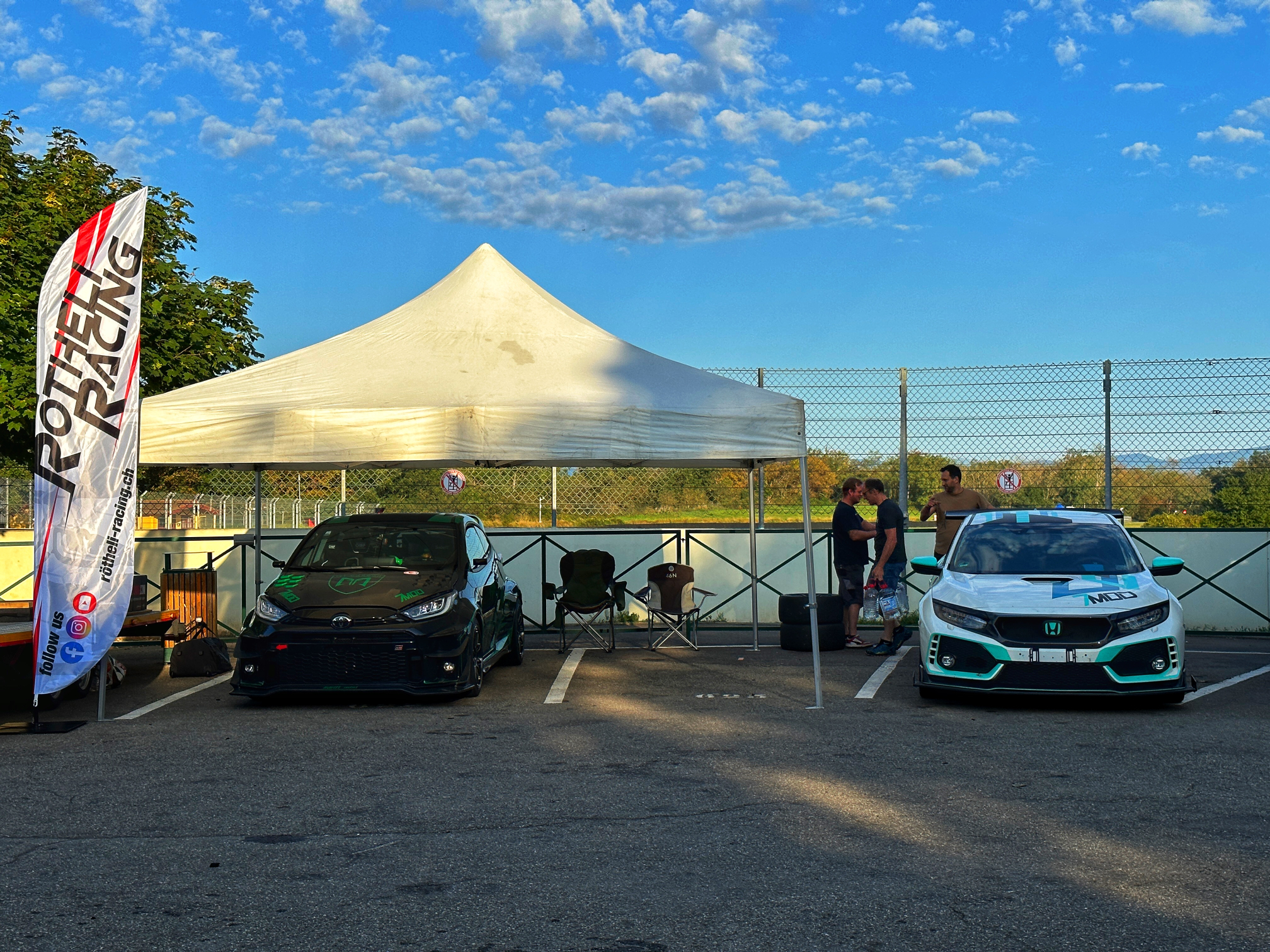
So yesterday was our first Rollout.
The car ran fine for about 5 laps and than we had a crash with a BMW M4…
Not pointing fingers, it was a racing accident.
If we hadn‘t both made a stupid mistake in a split second, nothing would‘ve happend…
I‘m just glad nobody got hurt and we „only“ have to repair two cars.
So for now the damages to my car are:
- left front Fender
- left front Headlight
- left front Öhlins Coilover
- left front brake disc
- left front Verkline Wishbone
- left front Verkline Tie Rod
- 1x Weds TC-105x
We‘ll make a video about it in a couple of days where you‘ll also see the onboard footage of the crash.
Here are a few pics of the damage.


The car ran fine for about 5 laps and than we had a crash with a BMW M4…
Not pointing fingers, it was a racing accident.
If we hadn‘t both made a stupid mistake in a split second, nothing would‘ve happend…
I‘m just glad nobody got hurt and we „only“ have to repair two cars.
So for now the damages to my car are:
- left front Fender
- left front Headlight
- left front Öhlins Coilover
- left front brake disc
- left front Verkline Wishbone
- left front Verkline Tie Rod
- 1x Weds TC-105x
We‘ll make a video about it in a couple of days where you‘ll also see the onboard footage of the crash.
Here are a few pics of the damage.

