GR Yaris (Gen 2) Toyota's Rookie Racing cooling setup at Super Taikyu

tonic

Totally Hooked
Joined
Aug 31, 2023
Messages
217
Reaction score
702
As many of you may know, Toyota uses the Super Taikyu (Super Endurance) series as a platform for developing their GR Yaris and GR Corolla. I thought it would be interesting to dig into some of the issues they are having on the track and the solutions they've implemented to address them.

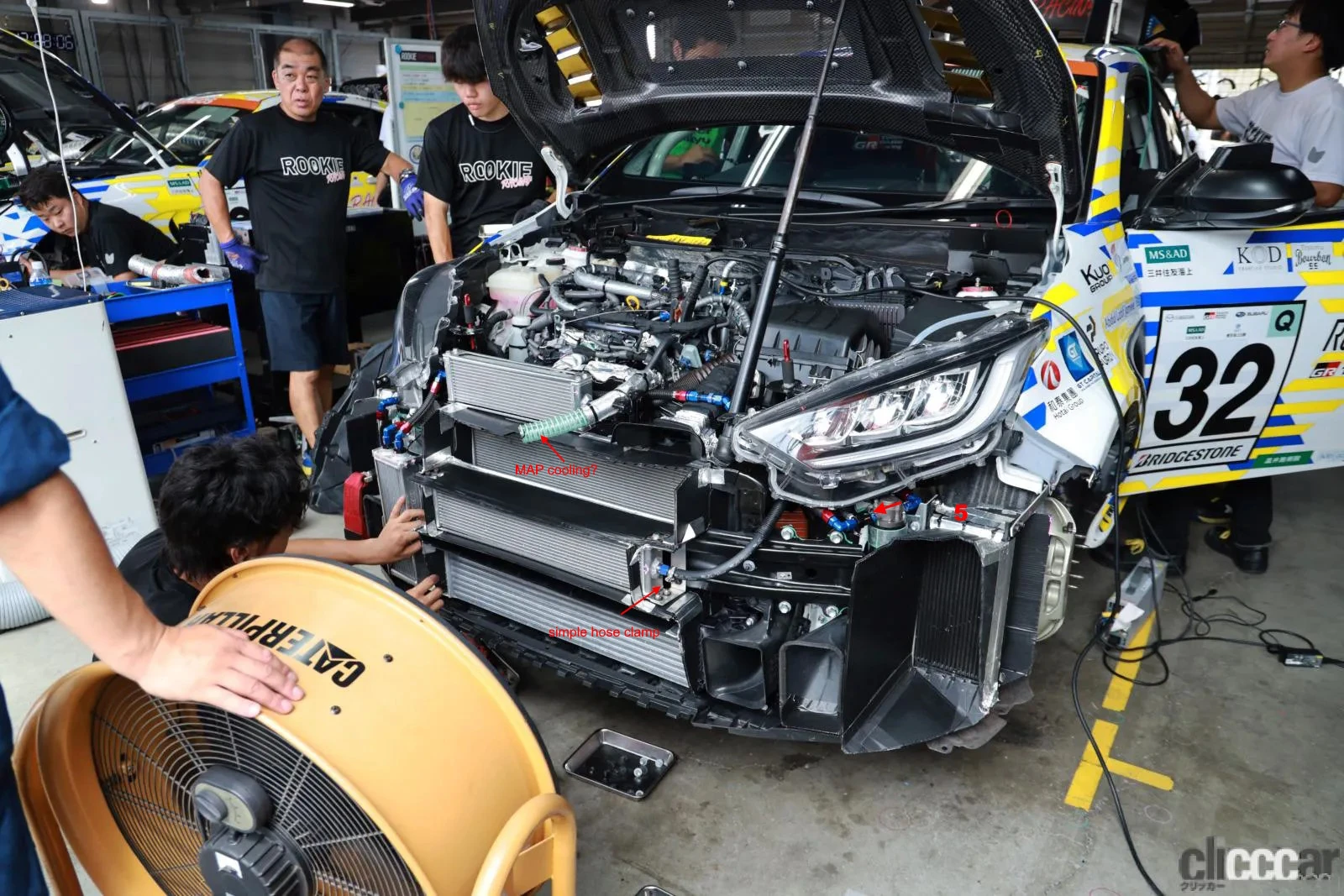
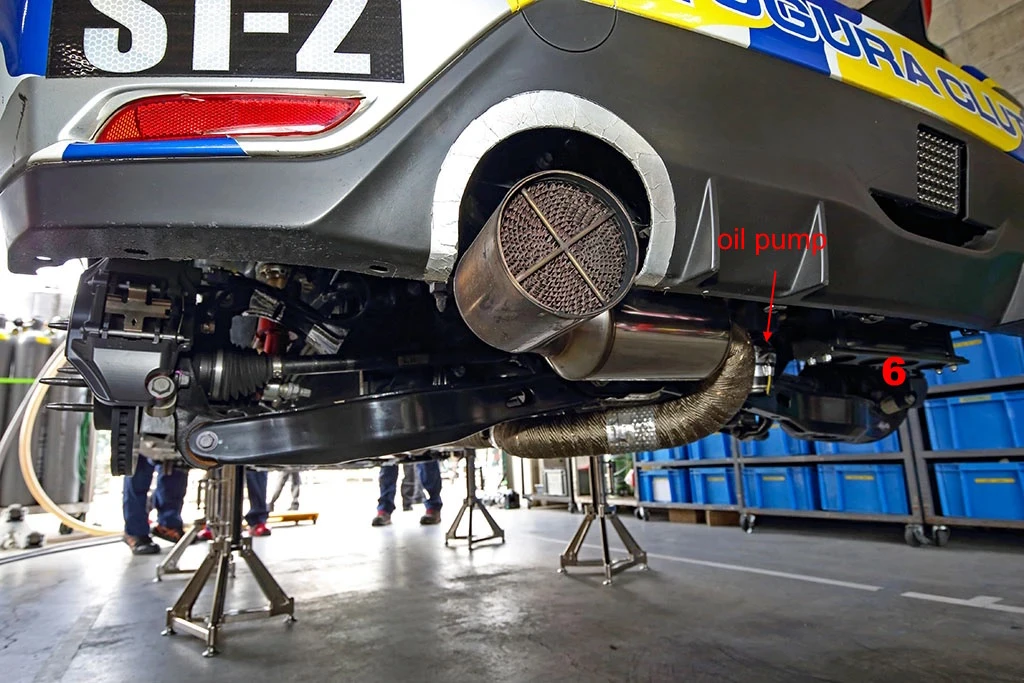
Here are a few photos from their 2024 GR Yaris development efforts. The car in the photos is equipped with a DAT8 gearbox and the cooling setup is nothing short of extreme :)

I tried to piece together what each component might be doing, but this is just an educated guess. Feel free to share your thoughts if you spot anything interesting.

My Guess:

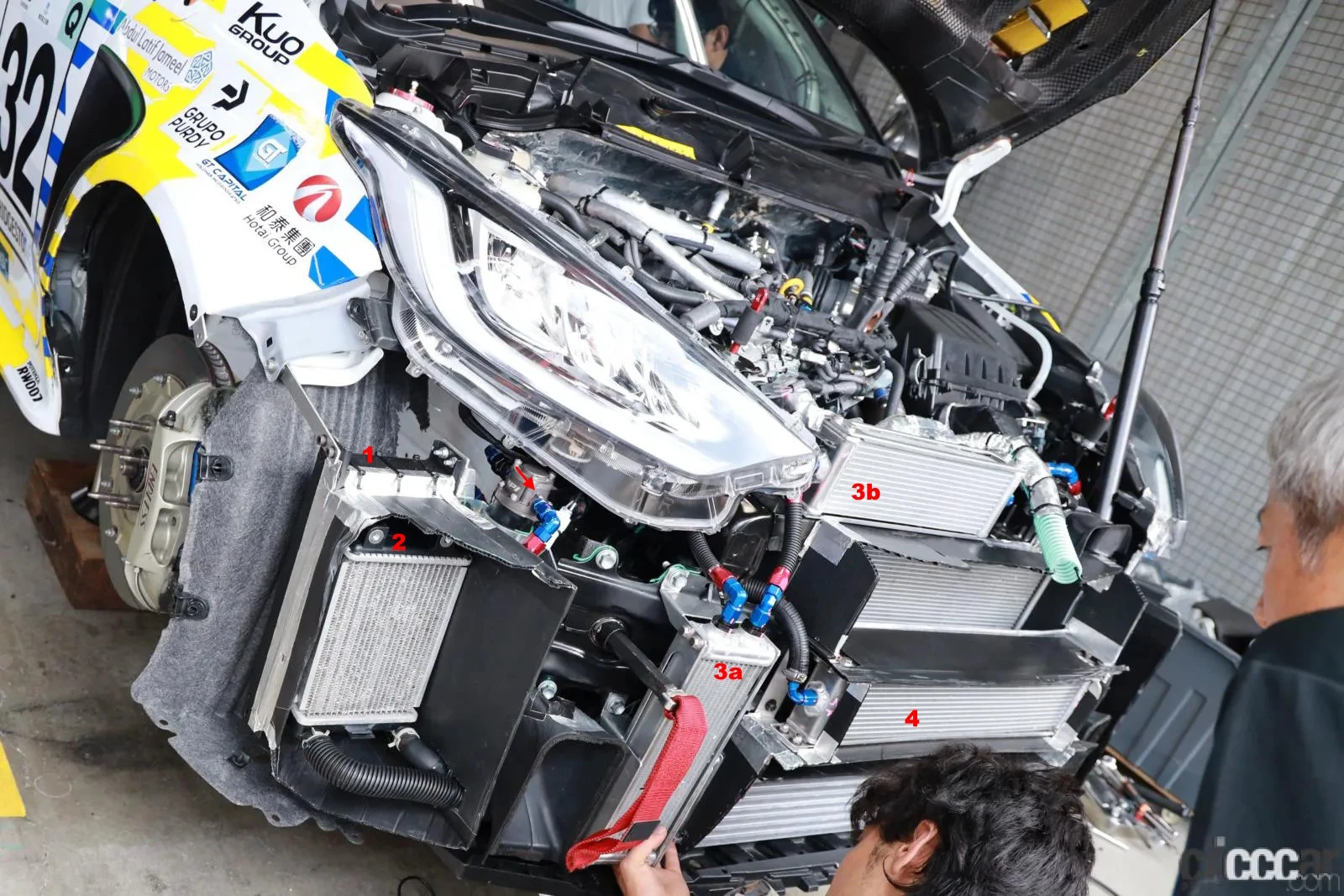
1 - Transfer case cooling. Seems to be connected to the RH HPI oil pump. Why is it located behind the coolant sub-radiator? My theory is that they might not be using temperature-based oil pump control, so the hot air ensures the transfer box oil doesn’t get overcooled. Or perhaps there simply wasn’t another suitable location for it.

2 - Additional engine coolant radiator. Judging by the hose diameter, this one seems fairly obvious.

3 (3a + 3b) - These two appear to run in tandem and might be connected to the LH HPI oil pump. My best guess is they’re used for cooling the automatic gearbox.

4 & 5 - Engine oil and fuel cooling? I’m unsure about these. Interestingly, No. 4 uses general hose clamps. Could that mean it operates under low pressure or isn’t as critical? Maybe something like driver seat cooling?

6 - Rear diff cooling.

You might also notice the seafoam green hose, which seems to be used for cooling some sensors. My guess it’s MAP sensor, possibly due to the placement of the 3b core it gets overheated.

I know there are more questions than answers here, but it’s fascinating to see how much effort goes into keeping this engine and gearbox functional during an endurance race.
Hopefully, you’ll find it interesting as well ;)
01.webp


02.webp


03.webp
 
Super interesting! Thank you! Do you have any more pictures? I am wondering how brake cooling is solved. I have always had a hard time finding information about Super Taikyu GRY in the English part of the Internet.
 
wow that looks simply crazy setup! No wonder heat is the nbr1 enemy for this car.
I counted 8 radiators in front from those two pictures.
 
Super interesting! Thank you! Do you have any more pictures? I am wondering how brake cooling is solved. I have always had a hard time finding information about Super Taikyu GRY in the English part of the Internet.
Yes, I have more photos, but I'm out for a few days and don’t have access to them right now. I'll post them as soon as I get back.

There are three teams running the GR Yaris in the Super Taikyu ST-2 class: Toyota’s Rookie Racing, Endless, and KTMS. All of them use the Endless 6-pot front brake setup, so it’s not really comparable to the stock brakes. As for brake cooling, I believe Rookie Racing is using a very simple setup. They have black, wire-reinforced hoses (around 60mm in diameter) connected directly to the standard front brake ducts, running all the way to the inner, central part of the brake disc.
 
A lot of ducting going on there. I guess you have to force the air where you want it to go.
 
Here are some more pictures as promised. The brake cooling setup of the Endless and Rookie Racing teams seems quite simple. But again, Endless uses 6-pot calipers don’t run any dust seals. They also use thicker brake pads, and I guess their brake pad compound is suited for significantly higher temperatures.

endless.webp


rookie.webp


There are some other interesting details in the Rookie Racing photo, where they are replacing blown engine:

M/T has an AN fitting in the refill hole. It might be used for cooling, as there’s an electric oil pump on the LH side. However, it doesn’t seem to connect to the black Setrab cooler because that cooler uses dry break fittings, and the hoses appear far too long to connect to the gearbox. It could potentially be used for quick M/T oil changes, though I’m somewhat doubtful.

I suspect the black Setrab cooler is located in the front center of the car, given the length of the hoses. But not sure what is it used for. The hose diameter seems too small for an engine oil cooler, and there’s no sandwich plate visible. Moreover, it appears they’re running a water/oil heat exchanger. Perhaps it’s for the transfer case?

Below is the cooling setup of the KTMS team. I’m just guessing about the purpose of their coolers.

ktms_1.webp


ktms_2.webp
 
Last edited:
Are they running higher power? Im interested to know when/ If restriction occures with the factory setup when power is increased.
ST-2 Class is allowed intake and exhaust modifications. Engine and transmission to remain stock. So, what are the chances that Toyota left 20+hp on the table with a poorly engineered air intake system, and then their own motorsport division sticks with it?

Motive Video in Australia dyno results when they tested found no power increase with an aftermarket air intake until you move past the stock turbo, cams, etc. But plenty of good sounds :)

Now, I don't want to make people mad, and I'd like to stay somewhat anonymous online, so I shouldn't say anything...but...I'm a development engineer (mechanical), as well as a field engineer. I get to play with an AVL AWD hub dyno that can supply air to the front of the car to over 60km/h, and we've instrumented and tested the hell out of this car for fun and "training." I can tell you that at full load and RPM, while the IAT does increase when the lower airbox inlet opens, the IATs you see in "dyno shootouts" and advertising for air intakes, likely using carpet-drying fans 9or no fans), is nothing remotely close to resembling what happens when the car is actually in motion. With a few simple mods, the IAT can be kept at ambient through the entire load/rev range (we did it).

You CANNOT test an air intake for power gains without having road-speed air on the front of the car. The GR Yaris air intake system is built on that.


But don't mind me. I'm just a cynical 'ol Gen-Xer who's just about had it with the modern automotive performance aftermarket literally making up problems that don't exist, and then make a part to "fix" it :)
 
The airbox heat soaks badly when the car isn't moving, or in really slow traffic. In this case, the upper inlet is sucking engine room air through the debris and water ejection ports. I closed those ports. Insulate the box with quality gold insulation tape.

This still leaves the issue of sucking engine room air into the lower duct when it opens. For this I built a shroud that surrounds the duct and ran a flexible silicone duct hose from the lower bumper air inlet directly to the shroud. There are also some oval openings in the radiator fan shroud that direct air into this area. For testing, I closed those off with tape.

Cruising at 60km/h, airbox temperature as measured at the airflow meter was 5-6° above ambient on a 30°C day but increases quickly when stopped or slowed down. At full throttle with the stock airbox starting at 2,500rpm, 60km/h air speed, and an 8" sweep, the temperature hits 45°C. With the ducting mods, cruising temperature was 2-3° above ambient, and on the same full throttle pull, the temperature drops to the same as ambient, 30°C.

The trick is simply to isolate the air being pulled into the airbox from the engine room.
Or buy the Forge carbon inlet duct to the lower flap, easy to verify by logging that it worked.
 
The airbox heat soaks badly when the car isn't moving, or in really slow traffic. In this case, the upper inlet is sucking engine room air through the debris and water ejection ports. I closed those ports. Insulate the box with quality gold insulation tape.

This still leaves the issue of sucking engine room air into the lower duct when it opens. For this I built a shroud that surrounds the duct and ran a flexible silicone duct hose from the lower bumper air inlet directly to the shroud. There are also some oval openings in the radiator fan shroud that direct air into this area. For testing, I closed those off with tape.

Cruising at 60km/h, airbox temperature as measured at the airflow meter was 5-6° above ambient on a 30°C day but increases quickly when stopped or slowed down. At full throttle with the stock airbox starting at 2,500rpm, 60km/h air speed, and an 8" sweep, the temperature hits 45°C. With the ducting mods, cruising temperature was 2-3° above ambient, and on the same full throttle pull, the temperature drops to the same as ambient, 30°C.

The trick is simply to isolate the air being pulled into the airbox from the engine room.
thanks for the hints, need to check those radiator fan schroud + that silicone hose bumper trick.
 
Or buy the Forge carbon inlet duct to the lower flap, easy to verify by logging that it worked.
I really like the idea and want to print one to try and log, but the original print file is gone. All I can find is the one for the entire box. Need to try before parting with that kind of money.
 
I really like the idea and want to print one to try and log, but the original print file is gone. All I can find is the one for the entire box. Need to try before parting with that kind of money.
Well it worked, logged it for 2 years on almost every drive, IAT barely goes up past 4krpm (1-2C from memory*) to redline, while OEM... well you know, you have the logs too.

*car and intake duct sold, just FYI ;)
 
Back
Top