
Does anyone feel that the clutch bite point is different in 1st and Reverse? It seems to me that the bite point in Reverse is quite a bit higher than 1st, especially when reversing up a slope. It's even harder to find the bite point in Reverse than 1st.
Navigation
Install the app
How to install the app on iOS
Follow along with the video below to see how to install our site as a web app on your home screen.
Note: This feature may not be available in some browsers.
More options
Style variation
You are using an out of date browser. It may not display this or other websites correctly.
You should upgrade or use an alternative browser.
You should upgrade or use an alternative browser.
GR86 GR86 - The clutch pedal thread
- Thread starter AndyRC
- Start date

@ZN8 ...did you get any further with this?I've been doing a bit of research on clutch springs recently and I have found other options than just the MTEC. These springs I have found are between £5 and £7 each as opposed to £32 that MTEC charge! They are also available in various spring rates giving you more options! The only downside is delivery is £12, I can bulk buy and distribute for cheaper but that needs some interest first.
The stock spring is rated to about 150lb/in, the MTEC is 65lb/in so about 57% weaker than stock. The options on the table rate between 85% and 58% weaker than stock. I will update this with info and supplier soon.
I've decided that I definitely need to replace the spring. Although I've got more used to the current one, and I know to anticipate the kick it gives as you lift the pedal, it still catches me out every so often and causes me to be a bit jerky. I really want to change the spring so I have that natural linear feeling clutch like I had in the GT.
I was all set to just bite the bullet earlier and purchase the MTEC one. Unfortunately, the ONLY UK supplier I can find is Tuning Developments, via their eBay store. I'm loathe to order from them because the last I heard they were having lots of problems which translated to atrocious customer service (taking money, but not delivering, not communicating) which is borne out in their eBay feedback. The only other option is to order from US suppliers who charge more than double the cost of the spring itself just to ship it (and that's before any unknown customs charges).
If you managed to identify an alternative I'd be interested.
Last edited:

James-UK
Totally Hooked
@ZN8 ...did you get any further with this?
I've decided that I definitely need to replace the spring. Although I've got more used to the current one, and I know to anticipate the kick it gives as you lift the pedal, it still catches me out every so often and causes me to be a bit jerky. I really want to change the spring so I have that natural linear feeling clutch like I had in the GT.
I was all set to just bite the bullet earlier and purchase the MTEC one. Unfortunately, the ONLY UK supplier I can find is Tuning Developments, via their eBay store. I'm loathe to order from them because the last I heard they were having lots of problems which translated to atrocious customer service (taking money, but not delivering, not communicating) which is borne out in their eBay feedback. The only other option is to order from US suppliers who charge more than double the cost of the spring itself just to ship it (and that's before any unknown customs charges).
If you managed to identify an alternative I'd be interested.
Yeah I don't want to deal with TD either... heard a lot of bad things and modded cars that went boom and they're not interested. That to me speaks volumes, don't ever wish to support a company like this.
I think I would try a spring too, I'm getting far better and use to the clutch, but at low speed it really does feel a bit wrong... at high speed I notice it far less.
Yeah, it's most noticeable at slow speeds and using the clutch pedal more slowly.Yeah I don't want to deal with TD either... heard a lot of bad things and modded cars that went boom and they're not interested. That to me speaks volumes, don't ever wish to support a company like this.
I think I would try a spring too, I'm getting far better and use to the clutch, but at low speed it really does feel a bit wrong... at high speed I notice it far less.
@ZN8 could you tell us where you found the springs you mentioned which might be a viable replacment?

Yes! I'm now over 200 miles in and have come to the conclusion the clutch spring needs to be changed. Especially driving back to back with a GT86, which has a heavier pedal and more feel (and that was supposed to be bad).Yeah, it's most noticeable at slow speeds and using the clutch pedal more slowly.
@ZN8 could you tell us where you found the springs you mentioned which might be a viable replacment?
The MTEC spring is massively overpriced. I have managed to source a UK spring supplier which will fit the bill, they have multiple options and I have listed those which I believe will fit based on knowing the dimensions of the stock spring and seeing it fitted, but as a disclaimer there is a little degree in assumption as I obviously do not have these springs in hand.
| Stock | MTEC | McMaster | GKTech | GKTech | Lee Spring | Lee Spring | Lee Spring | Lee Spring | Lee Spring | Lee Spring | Lee Spring | |
| Part No | - | - | 9657K379 | -33% | -66% | LC080L05M | LC105M04S | LC095L02M | LC105M04M | LC112M01S | LC112M01M | LC120M03S |
| OD | 1.06 | 1.06 | 0.97 | ? | ? | 0.97 | 1.095 | 0.97 | 1.095 | 1.095 | 1.095 | 1.095 |
| ID | 0.775 | 0.8 | 0.76 | ? | ? | 0.779 | 0.875 | 0.752 | 0.875 | 0.843 | 0.843 | 0.828 |
| Free Length | 1.65 | 1.7 | 1.75 | 1.75 | 1.65 | 1.75 | 1.75 | 1.75 | 1.75 | 1.75 | 1.75 | 1.75 |
| Wire Dia | 0.138 | 0.12 | 0.105 | 0.125 | 0.118 | 0.08 | 0.105 | 0.095 | 0.105 | 0.112 | 0.112 | 0.12 |
| Spring Rate | 150 lb/in | 65lb/in | 57lb/in | ? | ? | 23.2lb/in | 35lb/in | 39.7lb/in | 42lb/in | 49.5lb/in | 59.5lb/in | 64.3lb/in |
| Difference | 0% | -57% | -62% | -33% | -66% | -85% | -77% | -75% | -72% | -67% | -60% | -58% |
| Price | 0 | £32 | $10.57USD | $16AUD | $16AUD | £5 | £7 | £5 | £5.45 | £7 | £5.45 | £7 |
McMaster are a US hardware store, some American owners use this spring in their cars, however they don't ship to the UK, GKTech are an Australian supplier but have high postage fees, VIPmotorsports sell their products but not these springs. The UK supplier is Lee Spring https://www.leespring.co.uk/
Unfortunately before you go filling your basket and checking out, they have a £12.50 handling charge for orders less than £30, so you end up paying practically double the cost of the spring for handling. I totally understand why they would do that mind you.
I am happy to place an order for a number of springs to negate that charge and ship them out in a jiffy bag but I would need to know who would be interested.
I think the last one on the list would probably be best (64.3lb/in, £7) it looks to be the closest to the MTEC specification and that is at least a known quantity.
Count me in!
So we need 5 people to negate that handling charge. Me and you so far... @James-UK, @BanjoGazooey, interested?
Then we just need a couple more.
Count me in!
So we need 5 people to negate that handling charge. Me and you so far... @James-UK, @BanjoGazooey, interested?
Then we just need a couple more.
There's quite a few people on the US forums who've done this, but I'm not sure it's a good idea. With no spring, the clutch pedal will not kept in the fully up position when released. When pushing the pedal in, there'll be no free-play at all before you are putting pressure on the actual clutch hydraulics.Anyone completely removed it yet? I do feel the clutch is so light, it actually throws me off
This was one reason I put a selection of light springs on the list. For those who want the least amount of assistance but still retain pedal tension against the stop. I don't know how much pressure would be needed but it wouldn't be alot.There's quite a few people on the US forums who've done this, but I'm not sure it's a good idea. With no spring, the clutch pedal will not kept in the fully up position when released. When pushing the pedal in, there'll be no free-play at all before you are putting pressure on the actual clutch hydraulics.

Count me in too, trying to keep it smooth at low speeds when the wife is onboard is a nightmare.I think the last one on the list would probably be best (64.3lb/in, £7) it looks to be the closest to the MTEC specification and that is at least a known quantity.
Count me in!
So we need 5 people to negate that handling charge. Me and you so far... @James-UK, @BanjoGazooey, interested?
Then we just need a couple more.

My two cents: The progression (or should I say the unlinearity) of the clutch pedal doesn't feel correct to me. Therefore I reduced the "spring assistance" to make the clutch operation more linear, still retaining a bit of force to ensure a defined end position of the clutch pedal. This is the original spring (middle) and the "20% spring" (right) which is now fitted to my GR86:
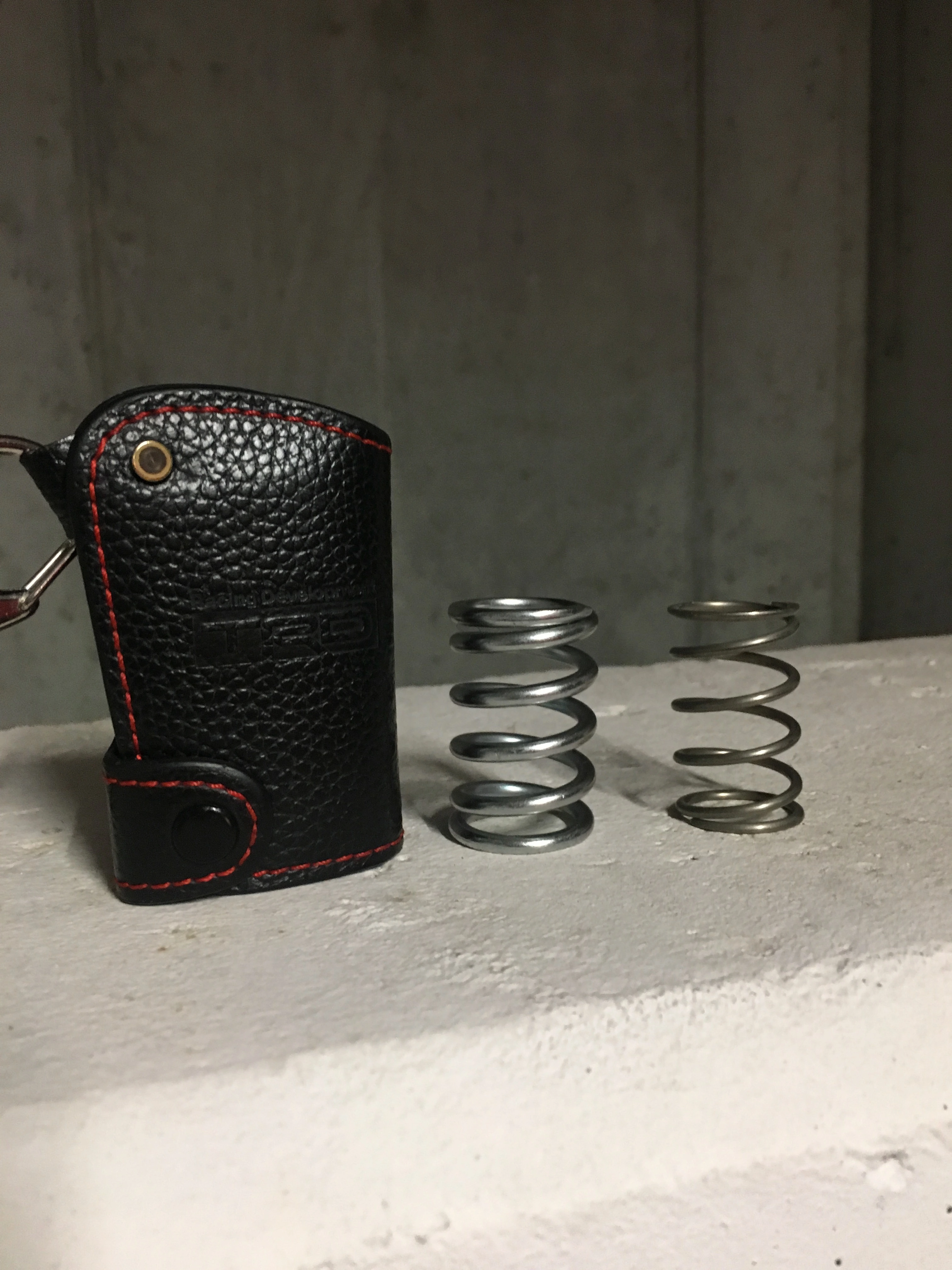
Clutch feeling is much more linear and it's easy to feel the "bite point". Hope this helps someone to decide
Bye for now Fred
Clutch feeling is much more linear and it's easy to feel the "bite point". Hope this helps someone to decide
Bye for now Fred
Kenco
Devoted member
I like the thought of lowering the clutch biting point, mine feels quite high up. I feel it would be easier to regulate if the bite was lower down.Has anyone tried lowering the clutch pedal (and therefore the bite point). There is an adjuster in the pedal box - might help. Think I’m pretty much used to the clutch now, but might lower it a bit anyway for comfort.
I’d love to hear from anyone who has tried this!
It's heavier than before, but still not too heavy (no measurement possible for me - no tools). Subjective it remembers me to the clutch on my Merc 280E, less force that on an older 911 needed, definitive much less than on a recent 911 GT3. Most important now it feels linear and harmonic like a clutch should feel in my opinion and it got a lower and well defined bite point. BTW my 20% equals -80% of the chart above and this is a standard spring a friend of mine selected from stock (cost ~€4.50). Take the sheet @ZN8 (you) provided and a ruler to measure/estimate the wire diameter in the pic I provided and you'be fine ordering the correct spring from stock. Thought about sending springs over, but I think this makes no sense due to customs and p&p...Fred how much heavier is the pedal with your 20% spring?
Bye for now Fred

86GR
Obsessed member
- Feb 11, 2022
- 319
- 405
Step by step guide here…..I like the thought of lowering the clutch biting point, mine feels quite high up. I feel it would be easier to regulate if the bite was lower down.
I’d love to hear from anyone who has tried this!
Clutch pedal adjustment
 www.gr86.org
I’ve spent quite a bit of time tonight watching videos on this and this is my opinion at 01:00hrs!
From what I’ve seen I think the “helper spring” reduction force needs to be either complete removal or more like -80% like @AP756 is using. The overall clutch feel can then be further improved by making the biting point coincide (or be just behind) the point where the spring switches its direction of force.
My course of action is now to contort my 6’2” middle aged frame into the drivers footwell to remove said spring and adjust the pedal position.
I will try and do this before Friday when the Invidia Q300 which has been sitting in my shed for 8 months will be fitted. I don’t want to stall the car when making a swift and purposeful exit from the garage that’s fitting it!
.
From what I’ve seen I think the “helper spring” reduction force needs to be either complete removal or more like -80% like @AP756 is using. The overall clutch feel can then be further improved by making the biting point coincide (or be just behind) the point where the spring switches its direction of force.
My course of action is now to contort my 6’2” middle aged frame into the drivers footwell to remove said spring and adjust the pedal position.
I will try and do this before Friday when the Invidia Q300 which has been sitting in my shed for 8 months will be fitted. I don’t want to stall the car when making a swift and purposeful exit from the garage that’s fitting it!
.
Just to add my two pence on the pedal adjustment - I did the same thing with my GT86, and it did help. However, I did it before changing the spring, and after I did that, I did end up fiddling with the adjustment a few more times over the years. But I think it was changing the spring which made the most difference.
I don't think the problem was ever so much the bite point, but it was that non-linearity caused by the spring which made judging the bite point so difficult. Adjusting the pedal may change where in the pedal throw the bite point occurs, and that might help if you move it further away from the point where the spring is suddenly changing that pivot point and giving you that lurch. But I think it would be worth changing the spring first, seeing how that feels, and then making any further adjustments.
There's also the complication that changing the pedal position might have an affect on the quality of the gearchange; you are effectively changing the length of the pedal throw, by moving the pedal along the rod which goes between the pedal and the clutch master cylinder, and this might effect the amount the slave cylinder moves - if you adjust the rod to bring the pedal down, it will physically bring the pedal down, yes...but it might also mean your clutch doesn't fully disengage, as even with the pedal fully depressed, the rod hasn't been pushed in as far as it would usually.
I remember having lots of similar discussions about this with the first gen - I even remember there was one guy who had constant complaints about the quality of his gearshift and adjusted his clutch pedal the opposite way to what most people are talking about here (ie, effectively raising the pedal position), and the result was that it completely cured his second gear crunch.
I just found a video which gives a better demonstration of how the clutch pedal adjustment has an effect (on a first gen BRZ, which should have the same setup as this car). If you go to about 1.18, you'll see where he has threaded the adjuster rod to it's minimal position, which lowers the pedal - but observe how it reduces throw of the slave cylinder and therefore the amount the clutch disengages. I think the optimal position is actually to have the rod set to it's maximum position that it can be without actuating the slave - that way, you get more 'throw' to work with. I ended up having it set like this on my GT86, and the result, along with the MTEC spring, was a clutch pedal that felt heavier, more linear and had a longer throw as it was actuating the clutch more effectively and it actually made shifting smoother as a result.
All this isn't to scare anyone off trying it - by all means, have a play with it, as anything you do is reversible. Just wanted to share my experience that I think changing the clutch spring is the biggest benefit as that sorts the non-linearity of the pedal, which is the crux of the problem. Pedal adjustments using the master cylinder rod can then be made to suit, if you still think the bite point is wrong. Just be aware, that you don't need to make BIG adjustments - you may find that a half-turn either way might have quite a noticeable effect, so don't go mad, and also, it might be best to take note of the starting position. You can get quite invested in fiddling with it (ask me how I know!) and it becomes very subjective to your level of feel, so it's always useful to be able to return to the default, factory position if you start to lose track of what adjustments you are making.
I don't think the problem was ever so much the bite point, but it was that non-linearity caused by the spring which made judging the bite point so difficult. Adjusting the pedal may change where in the pedal throw the bite point occurs, and that might help if you move it further away from the point where the spring is suddenly changing that pivot point and giving you that lurch. But I think it would be worth changing the spring first, seeing how that feels, and then making any further adjustments.
There's also the complication that changing the pedal position might have an affect on the quality of the gearchange; you are effectively changing the length of the pedal throw, by moving the pedal along the rod which goes between the pedal and the clutch master cylinder, and this might effect the amount the slave cylinder moves - if you adjust the rod to bring the pedal down, it will physically bring the pedal down, yes...but it might also mean your clutch doesn't fully disengage, as even with the pedal fully depressed, the rod hasn't been pushed in as far as it would usually.
I remember having lots of similar discussions about this with the first gen - I even remember there was one guy who had constant complaints about the quality of his gearshift and adjusted his clutch pedal the opposite way to what most people are talking about here (ie, effectively raising the pedal position), and the result was that it completely cured his second gear crunch.
I just found a video which gives a better demonstration of how the clutch pedal adjustment has an effect (on a first gen BRZ, which should have the same setup as this car). If you go to about 1.18, you'll see where he has threaded the adjuster rod to it's minimal position, which lowers the pedal - but observe how it reduces throw of the slave cylinder and therefore the amount the clutch disengages. I think the optimal position is actually to have the rod set to it's maximum position that it can be without actuating the slave - that way, you get more 'throw' to work with. I ended up having it set like this on my GT86, and the result, along with the MTEC spring, was a clutch pedal that felt heavier, more linear and had a longer throw as it was actuating the clutch more effectively and it actually made shifting smoother as a result.
Also, just to add, this step by step is for a US LHD car. The adjustment is much easier to make in a LHD, as the master cylinder rod is not located directly being the clutch pedal; in the RHD cars, the clutch pedal sits directly in front of that rod, and getting your fingers in to adjust it is much trickier. He also is unclipping the clevis entirely - if you're just adjusting the rod, that's not strictly necessary. You can undo the locknut, and just twist the rod within the clevis to adjust it - just placing a little pressure on the pedal as you do so will give it enough slack to allow it to turn easily.Step by step guide here…..

Clutch pedal adjustment
All this isn't to scare anyone off trying it - by all means, have a play with it, as anything you do is reversible. Just wanted to share my experience that I think changing the clutch spring is the biggest benefit as that sorts the non-linearity of the pedal, which is the crux of the problem. Pedal adjustments using the master cylinder rod can then be made to suit, if you still think the bite point is wrong. Just be aware, that you don't need to make BIG adjustments - you may find that a half-turn either way might have quite a noticeable effect, so don't go mad, and also, it might be best to take note of the starting position. You can get quite invested in fiddling with it (ask me how I know!) and it becomes very subjective to your level of feel, so it's always useful to be able to return to the default, factory position if you start to lose track of what adjustments you are making.
Last edited:
Further to the instructions above, here's a video showing the clutch pedal adjustment for a right-hand drive vehicle. It's for a first gen, but I assume (going by that step by step from GR86.org) that the assembly is the same, so this still applies.
You need to be a bit of a contortionist to do this. Easiest way was to put a pillow or something on the bottom of the door where the kickplates are, then lie on your back in the footwell with your feet outside the car. Might raise few of the neighbours' eyebrows though.
You need to be a bit of a contortionist to do this. Easiest way was to put a pillow or something on the bottom of the door where the kickplates are, then lie on your back in the footwell with your feet outside the car. Might raise few of the neighbours' eyebrows though.
Last edited:
