GR86 Good brake discs for track?

JoaoGR86

New member
Joined
Apr 7, 2026
Messages
11
Reaction score
3
Hello.

I use my GR86 on the track, and I’ve always had problems with the brakes.
I’ve been thinking about fitting a BBK, but I’m not sure whether I should try installing some brake discs more suited to track use first.

So far, I’ve fitted three sets of standard brake discs, with Ferodo DS1.11, PBS ProTrack and Ferodo DS3.12 pads.
The Ferodo DS1.11 pads cracked and fell apart in pieces; with the PBS and DS3.12 pads, the OEM discs warped badly and the pads wore irregularly.
I do cooling laps; at most I do 1 or 2 hot laps, and then I cool down, but I still have problems with the brakes.
I was going to fit DBA 4000 discs, but I’ve read this post and now I don’t know what to do https://www.gr-zoo.com/threads/avoi...e-the-gr-yaris-in-a-sporty-spirited-way.7342/

Which discs would you recommend? Or should I just go straight for a BBK?
 
  • Like
Reactions: tyu
Ola Ola ,No idea the quality for track but most us went with BBK they are reasonable for the price and easy to come by.
 
Im no expert on the 86 platform but my go kart has a beefier caliper than the stock ones on these cars.

I have uprated the pads in mine and they still don't fill me with confidence even on roads on downhil jaunts. There just isnt enough thermal capacity. If i were tracking the car I wouldnt waste any more money on upgrading the standard front brake discs / pads.
 
Ola Ola ,No idea the quality for track but most us went with BBK they are reasonable for the price and easy to come by.
Yes, the Godspeed one is a very good option, but the downside is that for the rest of Europe we have to pay customs duties, which makes it quite a bit more expensive.
I had a brake kit like that in mind, but I’m not sure whether the problem would be solved simply by fitting some track-oriented brake discs that provide better cooling, as this would be considerably cheaper than a brake kit.
 
Im no expert on the 86 platform but my go kart has a beefier caliper than the stock ones on these cars.

I have uprated the pads in mine and they still don't fill me with confidence even on roads on downhil jaunts. There just isnt enough thermal capacity. If i were tracking the car I wouldnt waste any more money on upgrading the standard front brake discs / pads.
Hahaha there’s no doubt that this car’s brakes aren’t up to the job. On mountain roads, with good brake pads that can withstand the heat, there’s usually no problem, but on the track there are still plenty of overheating issues...
 
then maybe air cooling kit ?
expensive but cheaper than BBK. other option maybe visit uk the nbuy the kit take it to Spain , or come by ferry and collect it =)

This one
 
I've got DBA 5000 series (330x28) on Reyland bells (using AP Racing hardware) and so far so good with a few hundred hard road miles and an Anglesey track day. OK the car isn't quite as hard on brakes as a GR Yaris would be but my discs look pretty much new still. RP-1 pads and GT3 ducts.

The cracking in that thread is interesting as it's directly between the mounting bolts, I wonder if it's an issue specific to that fitment?
 
The OE Spec DBA brakes are top quality, you shouldn't have any issues running these. I know several people who've run these without issue.

However based on these comments in the original post, it reads to me like your over working the brakes and not optimising the braking zones.

I use my GR86 on the track, and I’ve always had problems with the brakes.
with the PBS and DS3.12 pads, the OEM discs warped badly and the pads wore irregularly.
I do cooling laps; at most I do 1 or 2 hot laps, and then I cool down, but I still have problems with the brakes.

If you can only do 1 or 2 hot laps and then you have issues with the brakes or pad transfer (i.e. warp), this would suggest there is a fundermental issue with your braking approach. It's better to brake slightly earlier and have a consistance threshold brake force applied, rather than stamping on them at the last moment or braking too early and then dragging the brakes.

Also the three pads you've mentioned are race pads with a high mu. Having used a high Mu pad myself recently, I personal found they were too inconsistant as they provided me with less feedback through the pedal and braking traction, which meant I struggled to find an optimal braking point each lap. I struggled to understand why this was the case, until I read a post by Essex Brakes (USA), that confirmed what I was experiencing was related to running a high mu pad. This could explain why you've having issues with pad transfer, if your over working them, trying to find an optimal working window.

I'd actually suggest you should look at a lower Mu Endurance Pad, which seem counter intuitive, but they are easier to manage, modulate and usually last longer than the higher Mu options.

Take a look at the options such as the PFC 08, the Pagid RSL29 or the Winmax WN1.
[COLOR=rgba(255, 255, 255, 0.6)]These are all premium race pads, with good thermal limits and most importantly durablility. [/COLOR]


Its also worth me mentioning the original GT86 Cup cars, ran the OE calipers for NLS/VLN races, for several years, I'm 90% sure they ran the PFC 08, I mentioned above.
I also know a race team, that have ran multiple cars in multipe 24hr races with standard OE calipers, with a mix of Project Mu and CarboTech. - The caveat to this is, these teams will replace the pads and discs every race, but what I'm saying is you shouldn't have any issues with a couple of hot laps.

The main reasons to swap to a BBK is consumables, (a more efficient way to gain) thermal head room and looks.
 
The OE Spec DBA brakes are top quality, you shouldn't have any issues running these. I know several people who've run these without issue.

However based on these comments in the original post, it reads to me like your over working the brakes and not optimising the braking zones.


If you can only do 1 or 2 hot laps and then you have issues with the brakes or pad transfer (i.e. warp), this would suggest there is a fundermental issue with your braking approach. It's better to brake slightly earlier and have a consistance threshold brake force applied, rather than stamping on them at the last moment or braking too early and then dragging the brakes.

Also the three pads you've mentioned are race pads with a high mu. Having used a high Mu pad myself recently, I personal found they were too inconsistant as they provided me with less feedback through the pedal and braking traction, which meant I struggled to find an optimal braking point each lap. I struggled to understand why this was the case, until I read a post by Essex Brakes (USA), that confirmed what I was experiencing was related to running a high mu pad. This could explain why you've having issues with pad transfer, if your over working them, trying to find an optimal working window.

I'd actually suggest you should look at a lower Mu Endurance Pad, which seem counter intuitive, but they are easier to manage, modulate and usually last longer than the higher Mu options.

Take a look at the options such as the PFC 08, the Pagid RSL29 or the Winmax WN1.
[COLOR=rgba(255, 255, 255, 0.6)]These are all premium race pads, with good thermal limits and most importantly durablility. [/COLOR]


Its also worth me mentioning the original GT86 Cup cars, ran the OE calipers for NLS/VLN races, for several years, I'm 90% sure they ran the PFC 08, I mentioned above.
I also know a race team, that have ran multiple cars in multipe 24hr races with standard OE calipers, with a mix of Project Mu and CarboTech. - The caveat to this is, these teams will replace the pads and discs every race, but what I'm saying is you shouldn't have any issues with a couple of hot laps.

The main reasons to swap to a BBK is consumables, (a more efficient way to gain) thermal head room and looks.
I only do 1–2 hot laps because of the oil temperature; I don’t have an oil cooler, and with this car, it’s impossible to do more laps than that without reaching 130°C. What I meant to say is that, even doing this, I’ve always had problems with the brakes.

Honestly I consider that I brake ok—I brake hard at the start and gradually ease off using tailbraking until the apex of the turn. I have the best lap times for the GR86 on several circuits in Portugal, so I don’t think it’s a problem with my braking.

The PBS and Ferodo 3.12 pads haven’t had any issues as such; they kept braking well, and I don’t think they exceed their operating temperature range—it’s the brake rotor that warps and bends. And I think the brake caliper also gets too hot and doesn’t clamp the pad evenly.

I guess the GT86 Cup Cars with OE brakes has air cooling kits—maybe that could be a solution, even though they cost almost as much as a BBK. Also, a GT86 Cup Cars is 200kg ligther than our cars.

The reality is that a 294mm brake disc for a car weighing 1,340kg (4.56kg/mm) is insufficient for sports use. A Golf GTI has 360mm discs for 1,450kg (4.0kg/mm), an MX-5 ND has 280mm for 1,105kg (3.9kg/mm), a Yaris GR has 357mm for 1,375kg (3.85kg/mm), or an Alpine A110 has 320mm for 1,180kg (3.5kg/mm). It’s normal to have issues with the temperature with this brakes.

It might be worth trying brake pads with a lower Mu; I’ve always looked for pads with a high Mu because I thought they’d provide better braking and reduce my braking distance.
 
I only do 1–2 hot laps because of the oil temperature; I don’t have an oil cooler, and with this car, it’s impossible to do more laps than that without reaching 130°C. What I meant to say is that, even doing this, I’ve always had problems with the brakes.

Ok that makes more sense, sorry you didn't state this in the OP.
Get an oil cooler ordered asap.

The PBS and Ferodo 3.12 pads haven’t had any issues as such; they kept braking well, and I don’t think they exceed their operating temperature range—it’s the brake rotor that warps and bends. And I think the brake caliper also gets too hot and doesn’t clamp the pad evenly.

Obviously everybody is different with their approach when it comes to braking.

I suspect you are suffering with un-even pad deposits on the discs, causing the brakes to judder, giving you the sensation that they have "warped". Likely due to the pads being too high a mu, hot spotting and leaving an un-even transfer layer on the rotor.

To physical warp a disc would take a large amount of thermal energy and effort, which I doubt the stock calipers could deliver. You could check the run out of the disc diameter. If a disc was warped, it wouldn't just warp in thickness, its diameter would change.

Are you monitoring your caliper, pad and disc temperatures at all?
If not, and you want to do useful test before you spend any serious money on new pads, discs or a BBK, get yourself a set of thermal stickers, with a good range (120c - 280c) and stick them on the caliper (ideally it needs to be as close to the pistons as possible) and the disc hub/hat.

i.e: https://www.ebay.co.uk/itm/233346083175

1780684291280.webp


From the EBC website - https://www.ebcbrakes.com/technical...-temperatures-and-how-to-keep-on-top-of-them/:
Useful information (For guidance only) – When running a set-up that utilises multi-piston calipers, it is recommended that the working temperatures are sub-200°C, in most cases the highest acceptable working temperatures for calipers is 220°C.

If your calipers are operated at temperatures higher than 220°C, you will run the risk of overheating the seals equipped in your calipers and you may start to experience issues with sealing etc.

*If your caliper temperature runs higher than 220°C, the dust seals and fluid seals should be replaced.

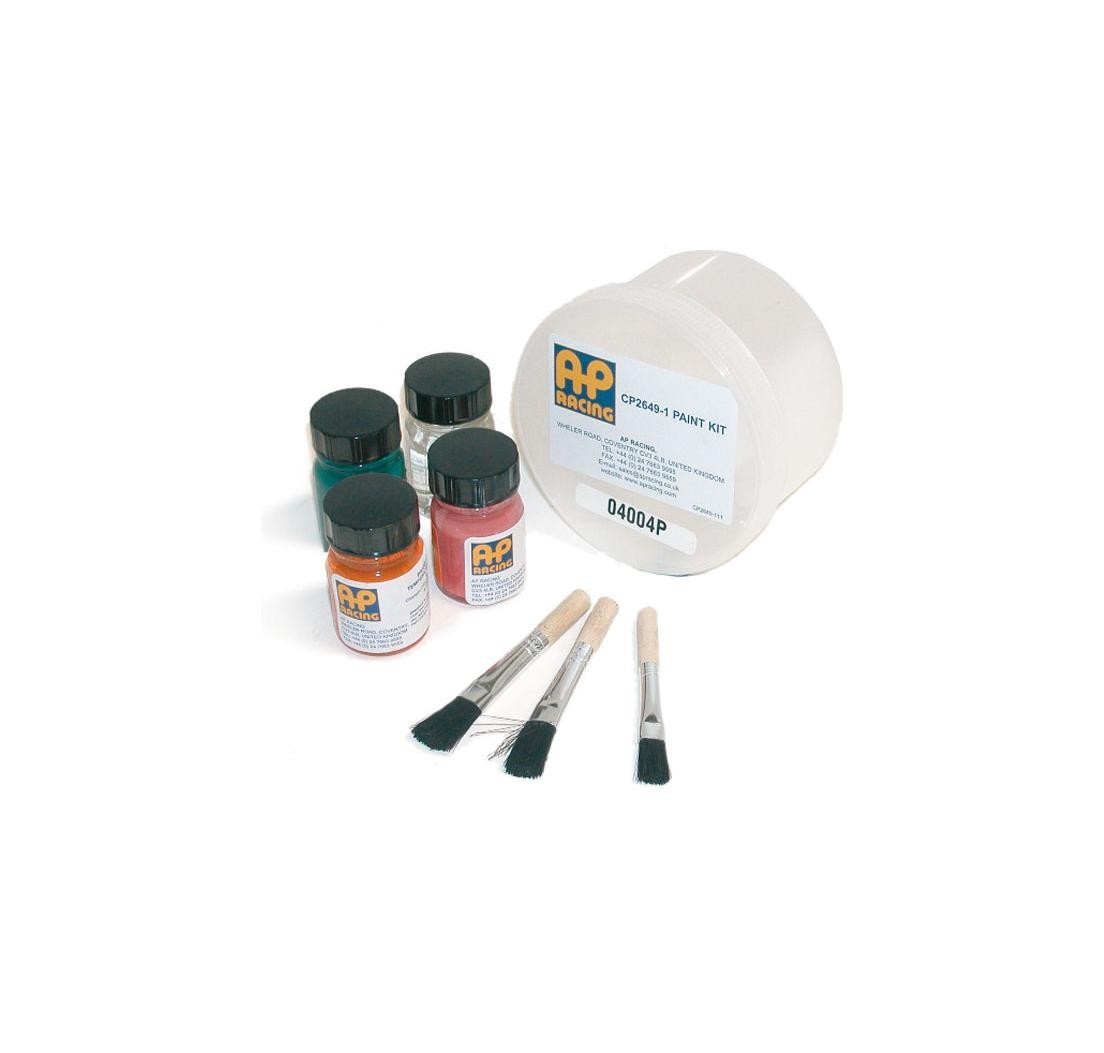
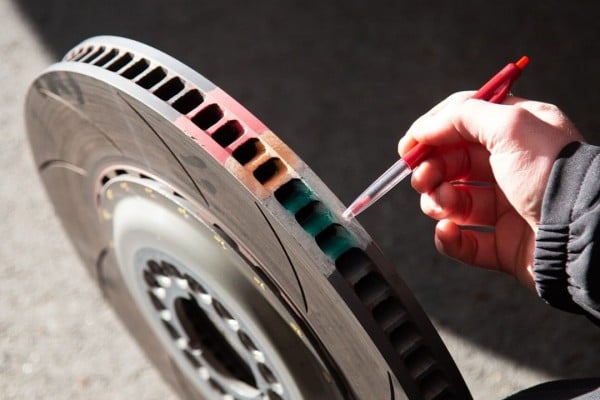
If you want to take it a step further get some thermal brake rotor paint, apply to the rotor vanes and the backing plate of the brake pads.

This will give you an indication of how hard you are working the brakes. Ideally if you know anyone else with a GR (or GT) you can ask them to do the same, this will give you a base line to work to.

1780684345691.webp


From an Alcon blog post.
Most race and semi-race compound pads require a temperature range of 300° to 800° C (572° to 1470° F) for optimal braking performance. This Brake Temperature Paint delivers the widest temperature range in one bottle. Temperature readings ranging from 0° to 800°+ C (0° to 1471° F) are displayed over a six color change from cold to hot.

Some other good sources of information.
 
Back
Top