GR Yaris Alignment, Camber and handling related talks

This is how I've always perceived it. With a touch of toe out you make the tiny initial movement of the wheel more direct. The sidewalls are pre loaded so none of that movement goes into that and they are trying to turn anyway once you pick a direction away from centre.

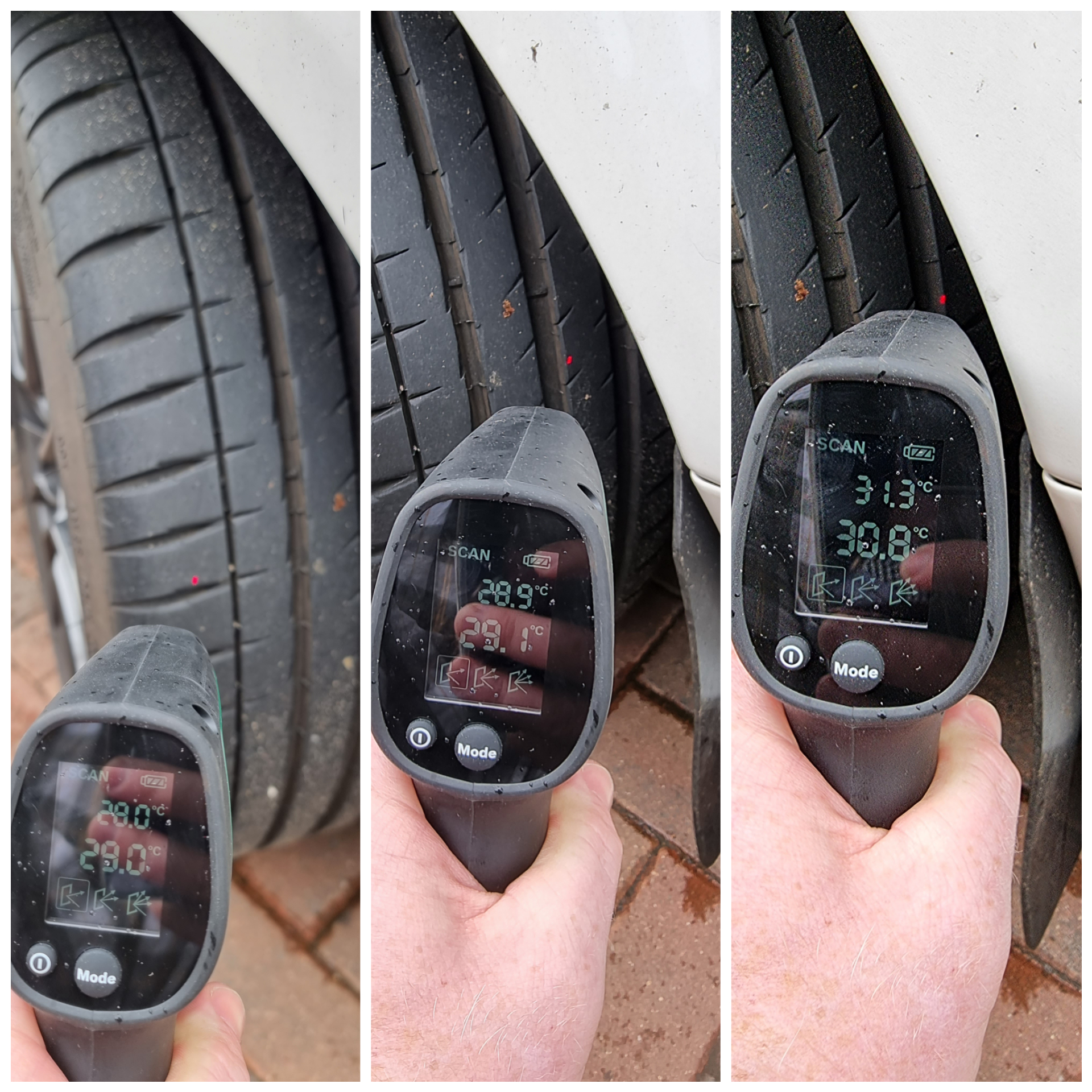
Over 20 mile run at 70mph on 4 min toe out and -3.5 degree camber:

inCollage_20210515_144007863.webp
 
This is how I've always perceived it. With a touch of toe out you make the tiny initial movement of the wheel more direct. The sidewalls are pre loaded so none of that movement goes into that and they are trying to turn anyway once you pick a direction away from centre.

Wouldn't the outside tyre with the most grip traverse the load from the pre-loaded inner edge across to the outer edge?

Would that not mean more movement because the tyre flex (loads) from inner to outer.
Just interested to hear the views of those who have tested these things. (theory vs experience I guess).
 
Just interested to hear the views of those who have tested these things. (theory vs experience I guess).

This is a very complicated subject. The best way of thinking of front toe and turn in is the fact that when you turn, the corner is sharper on the inside than the outside so it helps to have the inside wheel turned more.

On the rear the toe dictates how well the rear follows the front or wants to turn independently.

Worth noting the settings you apply down at the tyre shop will all change as soon as you brake, accelerate or turn so it's very much a case of knowing the basics and testing changes.
 
Indeed, chassis dynamics are complicated. That said, modern simulation software is very powerful and I must say modern cars suspensions are better then ever. Haven't driven a modern car (last 10 years or so) that was proper awful, plenty of those before.

However quantifying steering feel is very difficult. Believe it or not, most manufacturer/drivers don't want too much steering feel. So that's covered.

But for those that want feel, it varies a lot between cars and when trying to study it, you will find different answers from test subjects. I once participated in such a study but it was flawed. Imo it is best done by expert drivers and chassi experts, a la McLaren, Lotus and nowadays, also Porsche. No objective study, rather a craft.

But change one parameter or have one variable not under control, and you might have to start over...

Something like that.
 
Last edited:
My car is bone stock, I am at 15.000km, had ~6-7 track days, ~50km each, the rest is spirited road driving

My factory setup was quite off (Left/Right):
Front camber: -1.47°, -1.72°
toe: 1.9mm in, 1.1mm out
caster: 5.63°, 5.77°
Rear camber: -1.98°, -2.0°
toe: 1.4mm, 2.8mm in

I then had front Whiteline camber bolts (KCA417) installed, but the washer was incorrectly positioned so they could only set this:
Front camber: -2.45°
toe: 0°
caster: 5.65°, 5.92°
Rear camber: -2.0°, -1.95°
toe: 2.2mm in
Even -2.45° front camber upsets the cornering balance, the front had noticably more grip, steering was heavier, minimal tramlining

Then, I figured out how the camber bolt should have been properly installed, so I went back to get this:
Front camber: -2.95°, -2.93°
toe: 0°
caster: 5.78°, 5.83°
Rear camber: -2.0°, -1.93°
toe: 2.2mm in
BTW: for me, the Whiteline front camber bolts maxed out at -3.5°!

Now this is probably fun for a proper driver, but for me its part awesome, part scary :) . The front has enormous grip (even on B-roads), but its quite easy to upset the rear at higher speeds: lift-off or just a quick steering adjustment and the rear starts to turn. There's noticable but manageable tramlining on some roads.
The front tire temperatures are quite OK on roads(1-3°C inner-outter difference)
I am more than a second quicker on my used-to-be 43 seconds local track, even though I am just getting used to the new setup

In the meanwhile I got my rear camber bolts (Powerflex PFA100-12-70), fitting them tomorrow.
The plan now is to restore the balance, something like:
keep front camber -3°
add a minimal toe-in for better high-speed stability
set rear camber to -3°
and see how it goes. If that doesn't work out, I'll go back to ~2.5° camber front/rear
 
Today we installed rear camber bolts, they maxed out at 2.75° (+0.75°). Initially I wanted 3° but that would have been an overkill
This is my new geo:
Front camber: -2.83°, -2.9°
toe: 0.05° / 0.55mm in
caster: 5.72°, 5.85°
Rear camber: -2.75°, -2.7°
toe: 0.2° / 2.2mm in
I've only tested it on roads but I think I finally have what I wanted: superb grip, informative steering, great balance - the rear is also planted.
The annoying part of tramlining - gone! High speed stability is back.
It feels as safe as out of factory, but with much more grip and some tramlining only on very bad roads. Breaking stability is also great, but you can still swing the rear...
I'll try it on track this weekend...
Oh, I am on my stock PS4s and its -2...9°C, dry as in a desert... But I've tested the -2.5° camber on my Bridgestone Blizzak LM005 (stock size) and it almost cornered as a summer tire đŸ¤£ and I guess the overall vehicle behavior vs geo setup works for both summer and winter tires...
 
Here is where I'm at (left) right now. I experimented again with rear toe out after having the suspension done thinking removing a lot of the roll and stiffening it up would make that behaviour more predictable and controllable but I was wrong.

I also have whiteline rear bolts but couldn't get more rear camber - both people tried. Only added .3 for me - must be the lowering.

Oh this is just one bottom camber bolt up front. Less chance of it moving. The rest is from the DNA top mounts including the improved caster adding over 1 degree to total 7 degree.


20220304_160510.webp
 
Last edited:
This is how I've always perceived it. With a touch of toe out you make the tiny initial movement of the wheel more direct. The sidewalls are pre loaded so none of that movement goes into that and they are trying to turn anyway once you pick a direction away from centre.

Over 20 mile run at 70mph on 4 min toe out and -3.5 degree camber:

View attachment 1479
@DeanoC , have the tires on the pics seen a track day?
I'm close to ruining mine at ~10k km, about 400km on track (8 sessions). Thats what I'm partially trying to prolong with added neg camber
 
@DeanoC , have the tires on the pics seen a track day?
I'm close to ruining mine at ~10k km, about 400km on track (8 sessions). Thats what I'm partially trying to prolong with added neg camber

No they are my road tyres. Here are the track tyres. 1st pic 1 day at normal camber - see the outside is really worn. The 2nd pic after 2 more days at -3. I ruined the first set (225) in one day on the outer edges before adding the camber.

I check.with the heat gun when at track and they are really even - within 3 or 4 degree at 50 degrees inner, middle, outer

20210414_121909.webp

20210807_163047.webp
 
Last edited:
Mine fronts are showing pink colour on shoulder - did only maybe 10 hot laps. so stock camber is definitely not sufficient for track use.
That looks nice tire wear @DeanoC
 
both outstanding in their respective fields and poles apart one being a road tyre the other purpose designed track tyre
 
How would that translate in terms of lap times? Any real life examples?
 
How would that translate in terms of lap times? Any real life examples?
I personally am not keen enough to measure lap times in a non competitive pass time hobby although there are many who do and have done with these very tyres, check utube footage at Nordschleife
 
Back
Top